


September 23, 2026
Why Is My Backyard Quieter During Fall Migration? | BirdSnap

Among all the black-plumed birds, the raven holds a reputation distinct from the crow. It hovers through the realms of myth and literature, often serving as a messenger between the divine and the mortal.Its larger size, deeper, more resonant call, and intelligent gaze have cemented its role as a symbol of prophecy, memory, and arcane knowledge.
The most famous raven in English literature undoubtedly belongs to Edgar Allan Poe. His narrative poem, "The Raven," tells of a mysterious raven that visits a grief-stricken man, lost in sorrow over his departed love. The raven offers no comfort but responds to every desperate question with the single word: "Nevermore."
This mysterious and terrifying symbol has inspired countless writers and even popular culture.
Dickens's Grip, however, was an entirely different kind of raven.
Grip was a real-life raven, kept as a pet. Grip had a notable talent for mimicry and a mischievous personality.
Described by Dickens’s daughter Mamie as ‘mischievous and impudent’.
It was notorious for biting the children's ankles and bully the family’s Newfoundland dog, even stealing food right from under its nose. Grip learned many phrases, which once led a carpenter to lodge a complaint about it.
However, it is regrettable that it did not accompany Dickens for very long. Grip noticed that the workmen handled the paint carefully. It immediately developed a burning desire to possess it. While the workers were away, Grip ate about a pound or two of white lead the workmen left behind. This adventure ultimately led to its death.
In Norse mythology, the raven is closely linked to the god Odin. Two ravens, Huginn (Thought) and Muninn (Memory), always perch on his shoulders.
These birds acted as his eyes and ears, traversing the world to gather news.
Ravens also symbolized death and war. This connection extended to the battlefield through the "raven banner".It is a great pity that no raven banner has survived to the present day.
We can only learn from written records that the raven banner was a tall fabric flag with a raven pattern embroidered or painted on it.
In most Native American cultures, the raven is a very important symbol.
For the Lakota people, the raven represents transformation and the power to change. On the Northwest Pacific Coast, the raven is a shape-shifting trickster.
Similarly, Native Americans also see the raven as a messenger of the divine. People believe the raven helped create the world and connect the earthly and the sacred.
Among the Koyukon people, it is reverently called Tseek’aal, or “Old Grandfather.” When a raven flies over, people might shout, “Tseek’aal, bring us good luck!” or “Tseek’aal, drop a pack to me!”
If the raven seems to drop something while flying, it means the hunt might be successful. Otherwise, if the raven keeps flying straight, the hunter will go home with empty hands.
The most famous legend concerning the ravens of the Tower of London is linked to the Great Fire of London in 1666. It is said that after the fire, survivors began to drive the ravens away as they were scavenging among the ruins. However, Flamsteed explained to Charles II that killing all the ravens would be an ominous sign, and that the kingdom would not survive longer than the last raven killed. Consequently, Charles II issued an order to keep six ravens within the Tower of London.
There is also a belief that during the Middle Ages, cities were often chaotic. Ravens, due to their scavenging habits and bold nature, naturally gathered in urban areas and became part of city life. Over time, as ravens featured in various ancient folklore traditions, numerous legends grew up around them.
Regardless of the origins, these large black birds continue to soar over the Tower of London to this day, remaining one of London's popular tourist attractions.
Despite being veiled in layers of myth, both ravens and crows are real birds that share our world.Want to learn more? Check out the previous post.
For further reading, see the previous article.
Both ravens and crows belong to the genus Corvus and are widely distributed across North America. They are highly intelligent and often appear near human settlements.
Despite both being entirely black birds, they are actually quite easy to distinguish from each other if one observes carefully.
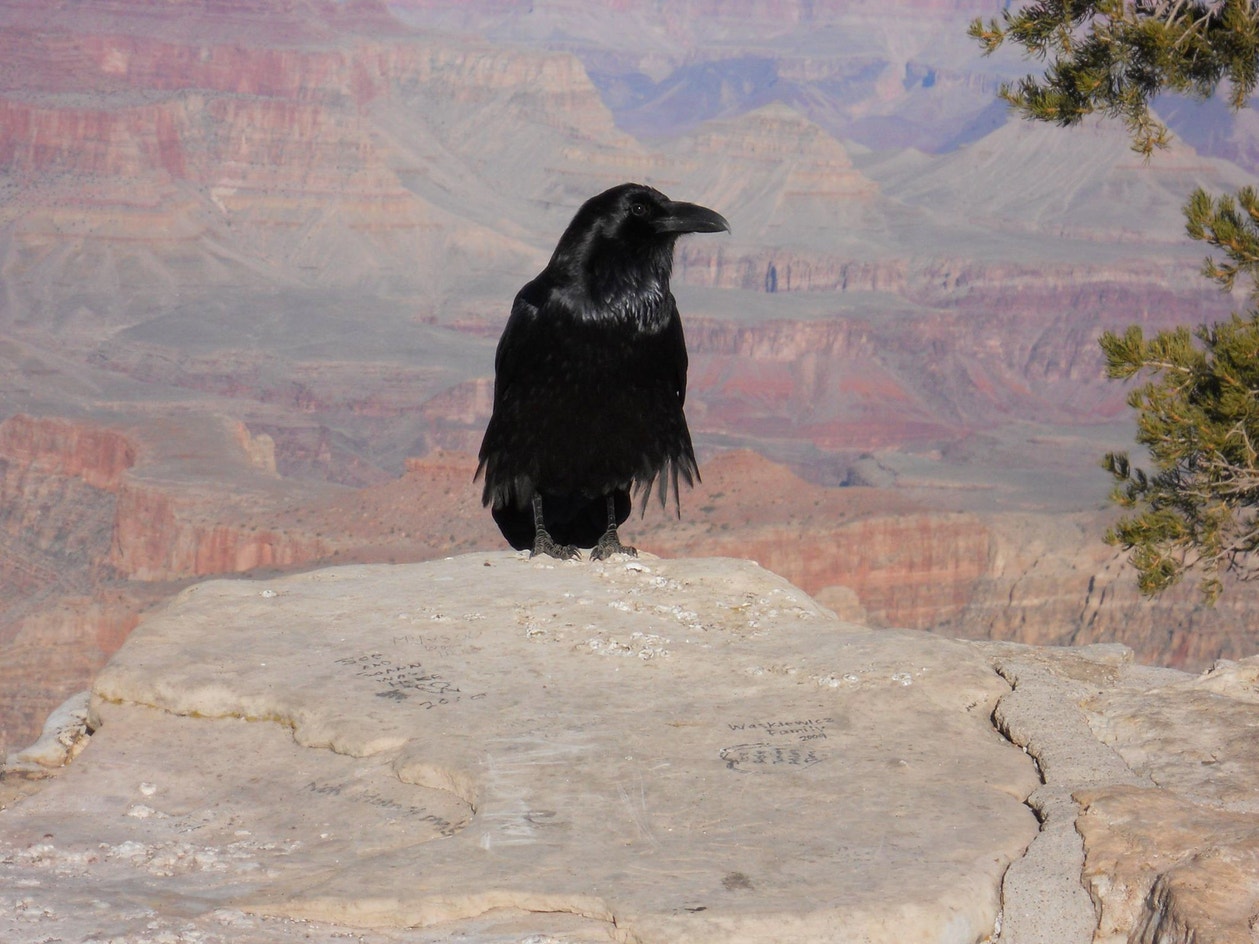
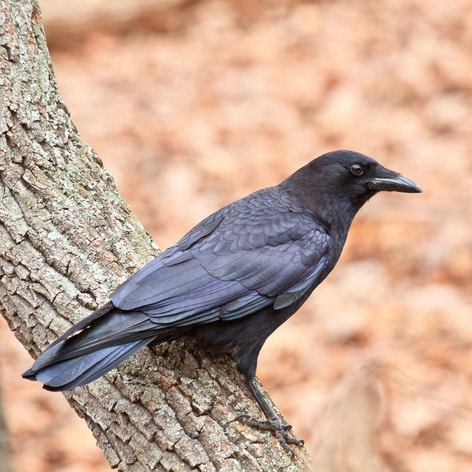
Ravens are significantly larger, with a wingspan that can be twice that of a crow, giving them an almost hawk-like silhouette. In contrast, crows have a more slender appearance and a wingspan of about 0.9 meters.
Wingspan refers to the straight-line distance from the tip of one wing to the tip of the other wing.
Another key distinguishing feature is the tail shape: ravens have a distinctive wedge-shaped tail, while crows sport a fan-shaped tail with feathers of even length.
If a bird lands close to you, you can observe more details. A raven’s beak is large, strong, and noticeably curved downward, giving a heavy and powerful impression. The crow’s beak is straighter, more slender, and blends more smoothly into the head.

Ravens also have shaggy throat feathers that resemble a beard, a feature absent in crows.
Neither ravens nor crows are known for melodious songs.
They can hardly compare to the singers of the nature, such as mockingbirds or thrushes. However, the best clue for identifying them is often their call. Ravens produce a deep, croaking sound, while crows emit a sharp, clear caw.
You can hear their calls here:
When you spot a large black bird perched nearby, maybe take a moment to observe. Beyond their shared cloak of mystery and dark feathers lies a fascinating world of distinct traits and remarkable intelligence. These are not mere omens or symbols, but neighbors that have adapted to thrive alongside us.
REference:
https://www.hrp.org.uk/tower-of-london/whats-on/the-ravens/
https://www.bbc.com/news/uk-england-london-55651104
https://aktalakota.stjo.org/lakota_spirit_animal/raven-k%C8%9Fangi-t%C8%9Fanka/
https://www.britannica.com/art/Raven-cycle
https://www.hrp.org.uk/tower-of-london/whats-on/the-ravens/
https://www.bbc.com/culture/article/20150820-the-mysterious-tale-of-charles-dickenss-raven
https://www.davidcastleton.net/poe-the-raven-dickens-barnaby-rudge-grip/
https://www.allaboutbirds.org/news/similar-species-crows-and-ravens/
https://urbannature.blog/2023/10/28/telling-crows-and-ravens-apart/
Nelson, R. K. (1983). Make prayers to the raven: A Koyukon view of the northern forest. University of Chicago Press.




Leave a comment