





September 23, 2026
Why Is My Backyard Quieter During Fall Migration? | BirdSnap


The Red-winged Blackbird (Agelaius phoeniceus) belongs to the family Icteridae, which includes New World blackbirds and orioles. Its genus name comes from the Greek agelaios, meaning "belonging to a flock," while its species name phoeniceus is Latin for "crimson" or "scarlet," referring to the male's most distinctive feature.Males are glossy, iridescent black birds, about 9.5 inches long, with bold red and yellow shoulder patches that stand out against their dark feathers. Females look very different: streaked brown and black with a pale eyebrow and heavily striped breast.
In spring, the Red-winged Blackbird is one of the earliest migrants to return. Males arrive at breeding grounds in early March, about a month before females. Older males come first to claim the best territories, followed by younger males, and finally the females. Upon arrival, each male focuses entirely on establishing his space. He picks a visible perch or bush, then sings his signature "kon-ke-ree" song to announce his presence.
These birds are bold and fiercely protective. They chase away much larger birds and even humans. If they come too close. When sensing danger, a Red-winged Blackbird first calls loudly to warn intruders. If that doesn’t work, it may swoop down and peck to defend its nest. Even well-meaning bird lovers refilling feeders can become targets.
The Ruby-crowned Kinglet (Corthylio calendula) might be one of the smallest, roundest, and most charming birds you'll ever encounter. As one of North America's tiniest songbirds, it measures just 3.5–4.3 inches long.
Its scientific name carries royal meaning: Regulus is Latin for "little king," referring to the male's hidden fiery crown, while calendula relates to the calends, the first day of the month, perhaps hinting at its early spring arrival. They spend much of the year hidden high in the canopy, but spring migration and breeding season bring them into view, offering a golden window for observation.
Typically, this bird is easy to miss: it sports plain olive-green plumage with two white wing bars and a touch of yellow at the wing edges. But in spring, the male raises a hidden patch of scarlet feathers atop his head because of excitement or courtship. During displays, he may crouch horizontally, flutter his wings, and sing to attract a female. These kinglets are constantly in motion, flitting through bushes and trees to capture insects.
The Summer Tanager (Piranga rubra) is a medium-sized songbird about 6.7 inches in length. It is now grouped with cardinals and grosbeaks. Males have a brilliant, uniform rose-red across the entire body. Females are mustard-yellow below and olive above.
First-spring males are among the most confusing birds to identify in spring. These are individuals that hatched the previous summer and are now returning north for their first breeding season. Their plumage is uneven: a patchy mosaic of yellow-green feathers mixed with emerging brilliant red.
The Summer Tanager is a long-distance migrant in the U.S. and Canada, though it can be categorized as both a migrant and a resident across its vast range. Early arrivals reach Florida before the end of March, but the main northward migration occurs from April to early May.This species has earned the folk name "bee bird." Beekeepers and farmers in the rural South and Southwest have long known the Summer Tanager as a predator of bees and wasps. It even raids wasp nests to eat the larvae.
Males arrive first, singing vigorously to claim territory and attract mates. Courtship involves energetic chases and food-carrying displays. Nest building begins two to four weeks after arrival; the female builds alone while the male accompanies her during site selection.
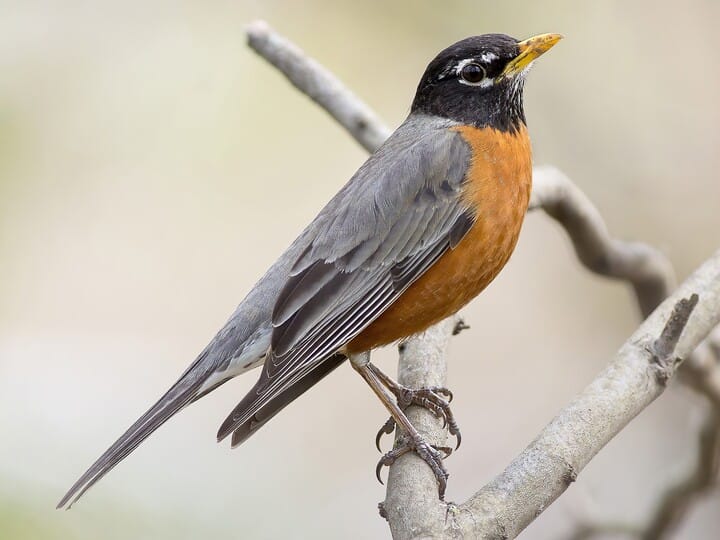
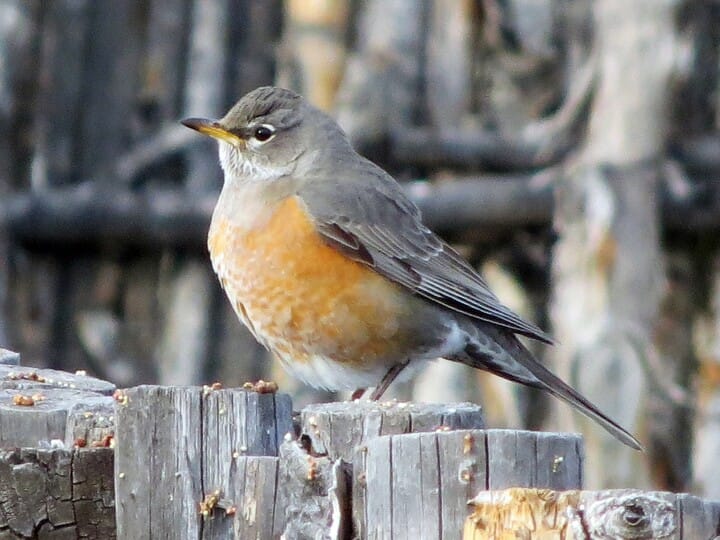
The American Robin is a familiar sight across North America. Despite its name, it is not related to the European robin. Instead, it belongs to the true thrush family (Turdidae) and is a member of the broader thrush group.The American Robin is a large thrush (9–11 inches). Males have rusty-orange breasts, dark gray heads, and white eye patches, while females and young birds are duller with brown heads and streaked breasts.
The American Robin is a "partially migratory" species. Some populations remain in their territories year-round, while others undertake short-distance movements or annual migrations of over 125 miles.Males arrive first at breeding grounds, quickly establishing territories through song and occasional fighting. Once claimed, they vigorously defend these spaces. When females arrive, multiple males may chase the same female. Once a female shows interest, the male performs a captivating courtship display. After she accepts a mate, the female builds a nest within his territory and begins incubation. Both parents become highly aggressive when defending the nest. So keep an eye out if they nest in your yard. You may need to adjust your mowing route and manage pets carefully.
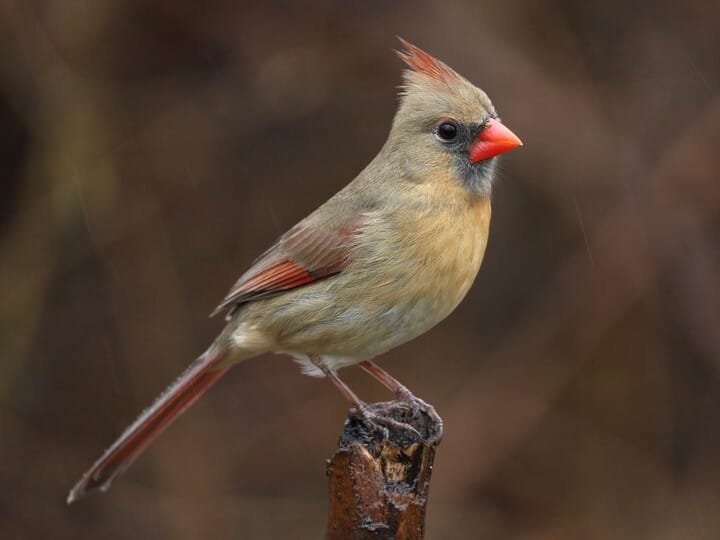
The Northern Cardinal is a permanent resident throughout its entire range. Males display unmistakable bright red feathers, with only the face and bill black: a striking contrast against spring's green foliage. Females are warm tawny-brown, but their wings and tails carry reddish tones.
This iconic color, however, is not inherent. It comes from carotenoid pigments found in the fruits and berries cardinals eat. Cardinals carry a gene that allows them to convert yellow pigments from their food into red ketocarotenoids, giving males their brilliant plumage.Both males and females possess this gene, so why don't females grow equally bright red feathers? Scientists do not yet have a clear answer. However, many female birds allocate carotenoids to their eggs. Perhaps female cardinals do something similar. This hypothesis, of course, requires more observation and testing.
Northern Cardinals do not undergo a dramatic spring molt. Instead, they complete a single full molt in autumn, growing new feathers with grayish or brownish edges. Throughout winter, these edges gradually wear away. By spring, the worn feathers reveal the brilliant red underneath, making males appear especially vibrant just in time for breeding season.
In spring, male cardinals sing more frequently and loudly, and chasing behaviors among males become easier to observe. Your feeder camera may capture a tender scene: a male feeding a female, a behavior that helps strengthen their pair bond.
The Blue Jay (Cyanocitta cristata) is a partial migrant, meaning some populations migrate while others do not. It is common year-round in the eastern U.S., but northern breeders travel south each fall.An adult Blue Jay measures between 11 and 12 inches in length. Its perky blue crest is an iconic feature. Other markings include a distinctive black necklace that extends from the back of the head around the throat, as well as black bars and bold white patches on the wings and tail.
In spring, the behavior of Blue Jays changes noticeably. During winter, they often gather in flocks. As spring arrives, these flocks break up as mated pairs establish territories for the breeding season.
If your backyard has trees at varying heights, you may spot several males following a female, hopping and bowing among the branches. And if your feeder offers enough space for these 11- to 12-inch birds to move around, your feeder camera might capture courtship feeding, a behavior where the male presents food to the female.
The Steller's Jay (Cyanocitta stelleri) is a close relative of the Blue Jay, found throughout western North America. It differs in appearance, with a charcoal-black head and neck contrasting against a vibrant, deep blue body. The wings show the brightest blue, often with a glossy sheen.
This species is mainly nonmigratory, though populations breeding at high elevations typically move to lower elevations during winter.In spring, a male Steller's Jay's plumage directly reflects his health and condition over the past year. Males that grew their feathers more rapidly produce feathers that reflect shorter wavelengths of light. Simply put they display a more intense, brilliant ultraviolet-blue. This signals better physical condition and makes them more attractive to females.
When a female shows interest, the pair engages in a behavior known as "sexual sidling." Both birds hop and move sideways toward each other in a coordinated, rhythmic dance. After a mate is selected, both individuals participate in choosing a nest site and building the nest together.
https://www.allaboutbirds.org/guide/American_Robin/overviewhttps://www.nwf.org/Educational-Resources/Wildlife-Guide/Birds/American-Robinhttps://inaturalist.ala.org.au/guide_taxa/181876https://inaturalist.ca/guide_taxa/186447https://ebird.org/species/blujay/US-MI-033https://www.britannica.com/animal/blue-jayhttps://birdsoftheworld.org/bow/species/stejay/cur/introductionhttps://animaldiversity.org/accounts/Cyanocitta_stelleri/https://www.allaboutbirds.org/guide/Red-winged_Blackbird?fbclid=IwAR368VrmO566uKwkBug2Fydeh0lV0zK2ZIDMNENgqbdPRM_cuGKFQUJUk_Ahttps://digitalcommons.unl.edu/icwdm_usdanwrc/1983/https://experts.illinois.edu/en/publications/spring-roosting-dynamics-of-red-winged-blackbirds-biological-and-/https://wwwencyclopedia.thefreedictionary.com/Regulus+calendula#cite_note-AAB-2https://www.allaboutbirds.org/guide/Ruby-crowned_Kinglet/overviewhttps://www.mendocinocoastaudubon.org/news/ruby-crowned-kinglethttps://www.allaboutbirds.org/guide/Ruby-crowned_Kinglet/overview?utm_source=Environmental+Education+Lessons+Week+3+For+You%21&utm_campaign=Enviromental+Ed+Week+3+2020&utm_medium=emailhttps://en.wikipedia.org/wiki/Summer_tanagerhttps://inaturalist.ca/guide_taxa/181864https://animaldiversity.org/accounts/Piranga_rubra/


Leave a comment